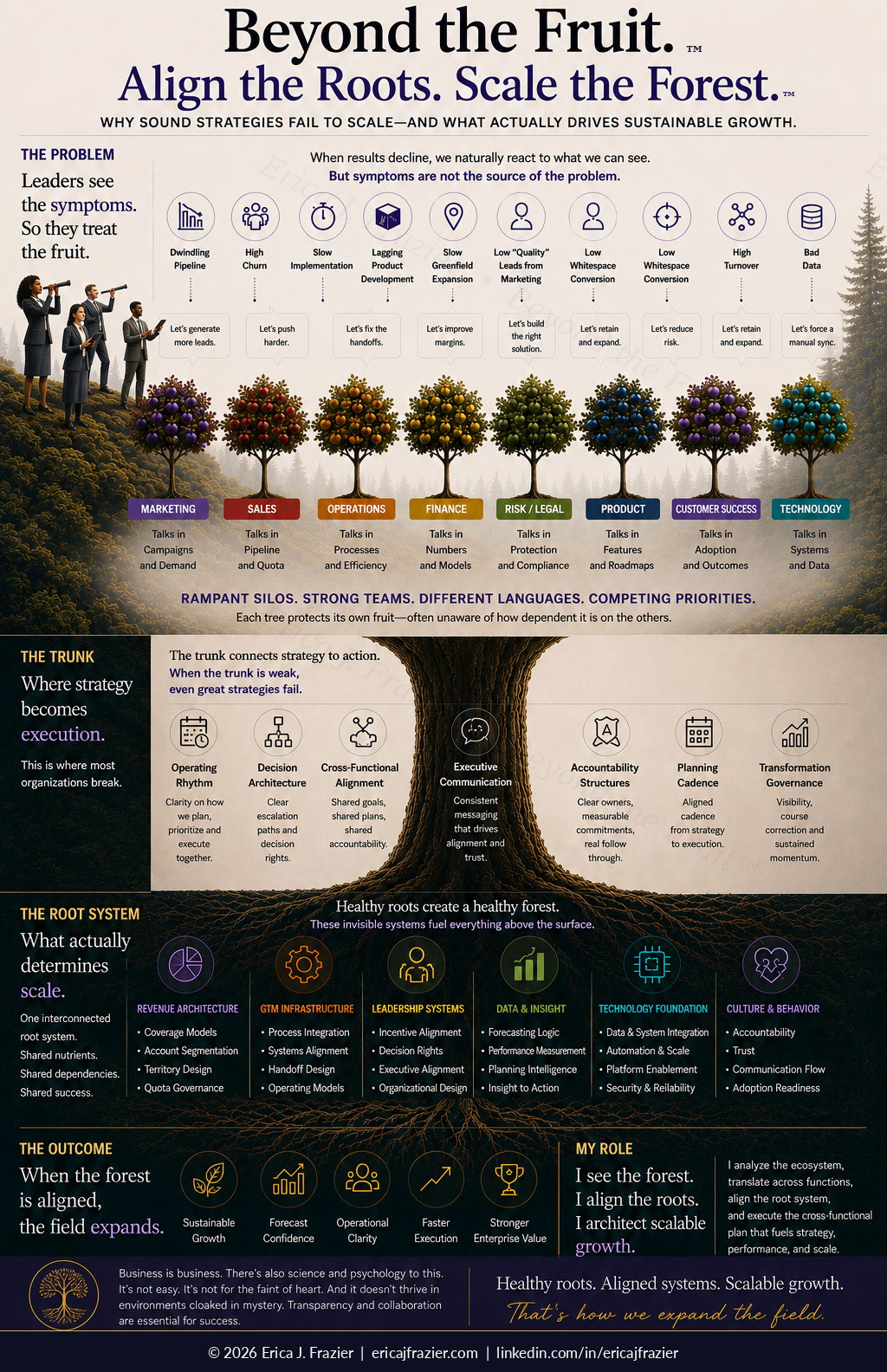
Executive Document
A one-page visual introduction to the Beyond the Fruit™ perspective.
A Commercial Architecture Philosophy by Erica J. Frazier
Align the Roots. Scale the Forest.™

Beyond the Fruit™ is a philosophy for understanding why visible business outcomes are often symptoms of deeper organizational conditions.
Organizations naturally focus on what they can see:
These outcomes matter.
But outcomes rarely exist in isolation.
Beneath every result are systems, structures, incentives, behaviors, and dependencies that shape what becomes visible above the surface.
Seeing the bigger picture changes how we understand the problem. The visual below offers a different perspective on what drives organizational performance.
Executive Overview
Executive Document
A one-page visual introduction to the Beyond the Fruit™ perspective.
The visual captures the idea. The story below explores the experience that inspired it.
For most of my career, I watched organizations chase outcomes.
When those outcomes improved, people celebrated. When they declined, people searched for someone to blame.
But over time, I noticed something. The conversations were almost always happening at the level of the fruit. Rarely at the level of the roots.
When performance begins to shift, the signals are often easy to recognize.
Revenue slows. Pipeline weakens. Customers leave. Growth stalls.
These are the outcomes leaders can see, measure, and report. Naturally, they become the focus of attention.
But recognizing a problem and understanding what created it are two different things.
A declining pipeline doesn't necessarily mean the sales team needs to work harder. Customer churn doesn't automatically point to a customer success problem. Slower growth doesn't always mean the market has changed.
The signal tells us where to look. It doesn't always tell us what needs to change.
That's where the deeper work begins.
Organizations are interconnected. A decision made in one part of the business rarely stays there.
A change in sales targets can affect capacity. A shift in customer acquisition can create pressure on implementation and service delivery. A process designed to improve efficiency can introduce friction somewhere else.
Each decision may make sense on its own. The challenge comes when those decisions are made without understanding how they affect the broader organization.
That's when the downstream noise begins.
Teams experience competing priorities. Processes become disconnected. Resources are stretched. People create workarounds to compensate for gaps they didn't create.
Over time, these consequences become problems of their own, often drawing attention away from the decisions and conditions that produced them.
What appears to be an execution problem may actually be a problem of organizational alignment.
Organizational challenges are rarely caused by a single, isolated issue.
Performance is shaped by the interaction of strategy, people, processes, systems, incentives, and behaviors. Each influences the others, whether those relationships are intentionally designed or simply allowed to develop over time.
Understanding those connections requires looking beyond individual functions and examining how the organization operates as a whole.
Where does strategy lose its connection to execution?
Where do responsibilities overlap or fall through the cracks?
Where do processes create friction instead of enabling progress?
Where are teams compensating for gaps in the operating model?
These questions reveal more than operational inefficiencies. They help uncover the conditions influencing performance and the dependencies that must be considered before meaningful change can occur.
The goal isn't to fix everything at once. It's to understand what matters, how the pieces connect, and where intervention will create the greatest impact.
Because sustainable improvement begins with understanding the system, not simply reacting to its symptoms.
The outcomes, the metrics, and the visible results. What leaders, boards, and teams are most often asked to explain.
The functions, teams, and people responsible for producing those outcomes.
The structures that create stability, alignment, consistency, and operational rhythm.
The systems beneath the surface: communication, governance, trust, accountability, and decision-making. The conditions that sustain performance long before outcomes become visible.
The broader organizational ecosystem where strategy, systems, processes, and people interact.
Organizations are not built from processes alone; they are built by human beings working within those processes.
When we focus only on systems, we risk overlooking the people operating inside them. When we focus only on people, we risk overlooking the systems shaping their experience.
Sustainable growth requires both. The healthiest organizations understand that performance and humanity are not competing priorities. They are interconnected parts of the same ecosystem.
Leaders are responsible for outcomes, but lasting performance requires more than managing what can be measured. It requires understanding how decisions, systems, and people influence one another, and recognizing that changing one part of an organization can affect many others.
When leaders understand those relationships, they can make more informed decisions, address underlying conditions, and create an environment where people and performance can thrive together.
That's why I look beyond the fruit. Not because the outcomes don't matter, but because understanding what produces them is how we create growth that lasts.
Beyond the Fruit™ is not a solution. It’s a perspective. A reminder to stay curious, to look deeper, and to ask better questions before attempting to optimize.
Because healthy roots create stronger systems. Aligned systems create healthier organizations. Healthy organizations create stronger forests.
And strong forests create the kind of growth that lasts.